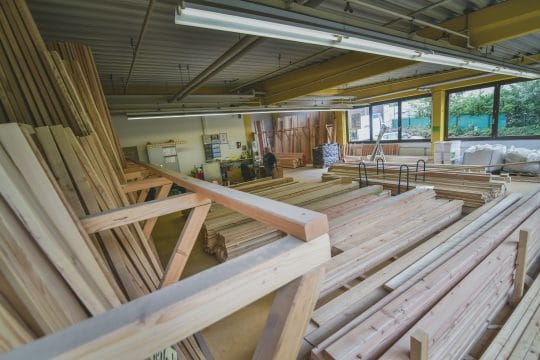
German rough-sawn plank
Buy rough plank now
What is RAUHSPUND?
German tongue and groove boards are characterized by their high density , strength , and durability , and are frequently used for roof sheathing, facades, intermediate floors in roof trusses, and formwork. They have a dark, uniform color and a rough, coarse texture, which gives them their name.
Tongue and groove boards are a type of wooden joint. The tongue and groove joint consists of a groove cut into one piece of wood and a corresponding tongue on the adjacent piece. The two pieces are joined by interlocking them. This type of joint is very strong and provides a secure connection for wooden parts without the need for nails or screws.
We will be happy to advise you on choosing the right products!

GELO rough-sawn boards
GELO tongue and groove boards are available in many dimensions and lengths.
Are you looking for special qualities or specific profiles? Thanks to state-of-the-art production facilities, we can fulfill many of our customers' special requests – all in the best and exceptional GELO quality, directly from the Fichtel Mountains!
Would you like to find out more about our production sites in the Fichtelgebirge? Then take a look at the production.
Applications of rough planking
German rough planked timber has a number of advantages that make it versatile:
- Shelf life: Rough planked boards are robust and durable, allowing them to be used for long periods of time.
- Stability: Due to its rough surface structure, rough planking offers good adhesion for screws and nails, thus providing a stable base for facades, etc.
- Moisture resistance: Rough planking is moisture-resistant and can therefore be used in damp environments.
This is where rough planking comes into play
- roof sheathing
- Facades
- intermediate floors in the roof truss
- formwork purposes e.g. in bridge construction
Request GELO rough-sawn boards now


Advantages of German rough-sawn boards
-
- stability and resilience
- Aesthetics
- water-repellent properties
- Storage
- versatile use

Buy GELO rough-sawn boards
Rough-sawn boards – Prices
We do not have any cost tables, but rather we agree individual prices with our customers. Simply ask and we will discuss everything else with you directly.
Order rough planking
You can order German rough sawn timber from GELO. You are free to decide which variant you would like to receive the timber in:
- spruce, pine or fir
- qualities I – III, II – IV
- Length: 3,00m – 6m, loosely spun
- finished dimensions e.g. 21/24/28 – 116/136/146 mm
- other dimensions available upon request
- upon request, technically dried or dip-impregnated
GELO – certification
As a regional company in the heart of the Fichtel Mountains, we have evolved from a traditional craft business into a state-of-the-art timber industry site . In 2001, our GELO plant in Weißenstadt was the first sawmill in Germany to receive the coveted PEFC environmental certificate.
Wood and sustainability – two matters close to our hearts that simply belong together!
GELO has multiple certifications regarding product safety and sustainability .



FAQ
What are typical applications for rough planking?
Typical applications for rough planking include roof trusses, wall and industrial cladding, and the exterior facades of log or garden houses. The tongue and groove profiles slide easily into one another, ensuring quick installation at the site. German rough planking is also durable and resistant to moisture, making it a good choice for outdoor use. Typical applications include: the exterior facades of log or garden houses.
Where does the term "rough-sawn plank" come from?
Rough-sawn plank is a woodworking term that comes from German. The term "rough" describes the uneven or rough surface of a piece of wood, while "plank" refers to an elongated piece of wood used to reinforce or connect wooden structures. Together, the term "rough-sawn plank" refers to an elongated piece of wood with a rougher surface that is used in woodworking.
Why use rough planking?
Rough joints are used in woodworking to reinforce and connect wooden structures. Their rough surface provides a larger adhesion surface and thus increases the stability of the connection. Rough joints can also be used to align and adjust wooden parts.